How to write better books using chiastic structure on a macro and micro level
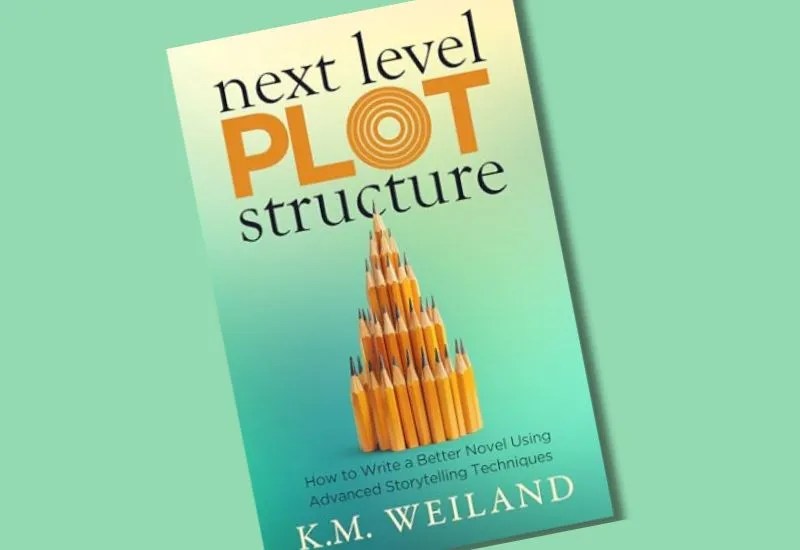
I’m such a sucker for writing craft books! I appreciate everything that K. M. Weiland puts into the world, so when her new book came out, I grabbed it. I’d never seen a plotting book that focused heavily on chiastic structure. That’s what sold me.
Chiastic structure is an age-old technique that I recognized from the Bible, but it spans a range of literary traditions over time. It’s where the first half of the story mirrors the second half in such a way that the book has a pleasing symmetry, and the story feels complete. The midpoint, as the mirror moment (made popular by James Scott Bell) has no pair but instead mirrors itself.
I was surprised to read about how each of the plot points has a chiastic structure within itself, and how scenes have a type of symmetry to them as well. It’s helpful to look at structure like this, as a series of questions and answers or openings and closings.
This book could be a tad more relatable and the writing jazzier, but Weiland does insert a good amount of her personality into the text.
One day, I will write a novel and pour all of my knowledge into it…just kidding! For now, at least, I will just read writing craft books like the junkie I am.
This was just plain fun to listen to on audio. I’m not a writer of novels, but I am a reader of them. I’m interested in why some stories work and others don’t. This book sets forth 20 plot skeletons that writers over the centuries have used as a basis for some of the most enduring stories of all time. Why do they work?
Well, they have certain elements in common. Without those elements, the plot doesn’t ring true—or it just skids off the path and into muddlement, leaving the reader confused. All of the plots, too, touch certain foundational human impulses, desires, and questions.
Ben-Hur is a revenge plot
Beauty and the Beast is a transformation plot.
Othello is a wretched excess plot.
It’s neat to look at these skeleton plots and see how different authors and writers apply them, whether unknowingly or purposefully. For example, I was watching the 1982 version of Annie with my boys, and I realized that it’s an ascension plot. More than anything else, it’s about Annie (a magnetic central character around whom everything revolves) and her rise from a poor, unloved orphan to the cherished daughter of a billionaire.
I don’t pretend like this book is the ultimate and last word on plots. It’s just interesting information to add to my foundation as a literature nerd. Since this was written back in the ’90s, it comes from a strong Western, Judeo-Christian worldview, and, therefore, it makes a lot of sense when you stand it up next to the Western canon (naturally). There are other storytelling traditions outside of this worldview, but those aren’t mentioned.
I’m not writing fiction, but writing craft books have been catnip for me lately. WHY?
I love the ideas and frameworks that authors use to write fiction. It’s so interesting to me. I enjoy seeing how (and if) well-done books align with these (now iconic) story beats, and how they fall into one or more of the 10 thematic categories that she identifies.
I understand why some people strongly dislike “formulaic” books like these. I’m not a huge fan of big promises like “follow these steps and write a bestseller,” but I’m not wholly unconvinced that this beat sheet isn’t useful to writers, especially new writers. It sure is interesting, I’ll give it that.
Because I’m not an author, I feel serenely removed from this debate, watching from afar on my reader’s couch.
Why did I choose the YA version instead of the original? Because it’s newer, and I wanted to see if Brody revised any of her earlier advice. I don’t think there are any major differences.