“Public policy can help, but there is no government that can fix these problems for us.”
I cannot agree more with J.D. Vance’s statement here. In this memoir, he describes a web of personal, cultural, and spiritual problems that are so interconnected and tangled that there are no easy solutions.
J.D. Vance, our soon-to-be Vice President, grew up with a bunch of lunatic hillbillies and dysfunction upon dysfunction. A snapshot: Substance-abusing mom, revolving door of “dads,” constant uncertainty and conflict in the home, no special talents or intelligence to distinguish him. How did he rise above that to become a U.S. Marine and Yale Law School grad—and eventually the second-in-command of the most powerful nation on earth?
If we can simply take J.D. Vance’s experience and replicate it through government policies and laws, then everyone, no matter their situation, should be able to achieve what he did, right?
Of course not! I love that, instead of writing a political book, Vance decided instead to write a memoir, describing what it was like to grow up the way he did. He says again and again that, while he’s not skeptical of public policy, it wasn’t anything the government did that tipped the scales in his favor. It was the people in his life. He describes in the last chapter of the book how close he came to falling through the cracks. If just one family member, teacher, coach, or friend didn’t intervene for him at a critical point in life, he could’ve easily changed trajectory for the worse.
I believe the problems we face are spiritual at the root.
I have a Rich Mullins CD with one of those hidden tracks at the end. This track is at least an hour long, and it’s filled with snippets of Rich’s commentary during concerts and such. In one of them, he says something like this: You know, the scary thing about God is that he didn’t make a Plan B. He created the church, and he gave us a job, and if we don’t do it, there’s no Plan B. The church is the only thing that can make a real difference in this world. The government can’t do it, so stop trusting in the government. Educational systems can’t do it, so stop trusting in educational systems. God formed the church, and it’s our job.
I’m butchering it, but it resonates now more than ever.
One small book for moms. One giant leap for momkind.
Abbie is so encouraging—even when she’s serving up scriptural truths that taste more like cabbage than candy. She is solid, and this book is solid. I wasn’t sure how much she could possibly say on this topic, but I knew that I needed to read it because I loved M Is for Mama so much.
This was a quick listen on audio and a total shot in the arm. I will say something: Even though I listened to this on audio straight through in maybe three days flat, I think that I would benefit greatly from reading a page or two a day in print. The book (as well as MIFM) is so fantastic and necessary that I’d benefit from a daily dose.
Abbie (homeschool mom of 10) proclaims that hard is not the same thing as bad. Just because something is hard doesn’t mean it’s necessarily bad and you should remove it from your life.
On the other hand, just because something is hard doesn’t mean it’s good and sanctifying and needs to stay.
Abbie doesn’t minimize the truly hard things. She describes growing up with her dad who was undiagnosed bipolar for many years. She talks about mom friends who weren’t true friends. She talks about the very real challenges of having newborns, toddlers, and teens—even when they’re perfectly healthy and happy, they are hard!
Sometimes, we cannot do anything about the “hard” except patiently wait and hope for the day that God lifts the burden from our shoulders (or the day when we realize that we have increased in strength to the point where the load doesn’t feel heavy anymore). Other times, we can prayerfully take action to ease unnecessary hardships (or trade the “hard” of disobedience for the “hard” of obedience).
I love the chapter where she makes a distinction between “hard things” and “suffering.” They are not the same thing. Often, hard things we face as moms are “challenges” that we tackle and overcome with a hopefully positive result. Suffering is something else altogether. Abbie refuses to accept that motherhood is suffering. That mindset may FEEL true, but it’s NOT helpful, and I couldn’t agree more. I’m saying this from the perspective of someone who does often feel like I’ve sacrificed a lot to stay at home and homeschool my boys. I can make an idol of my so-called suffering, or I can put it into proper perspective and increase my joy and peace.
This book is high on inspiration and mindset—the whole book is about shifting perspective so that we, as moms, can invite God more fully into our hard days and even into our suffering. But, as always, she offers some practical action items to consider (but not too many that it’s overwhelming).
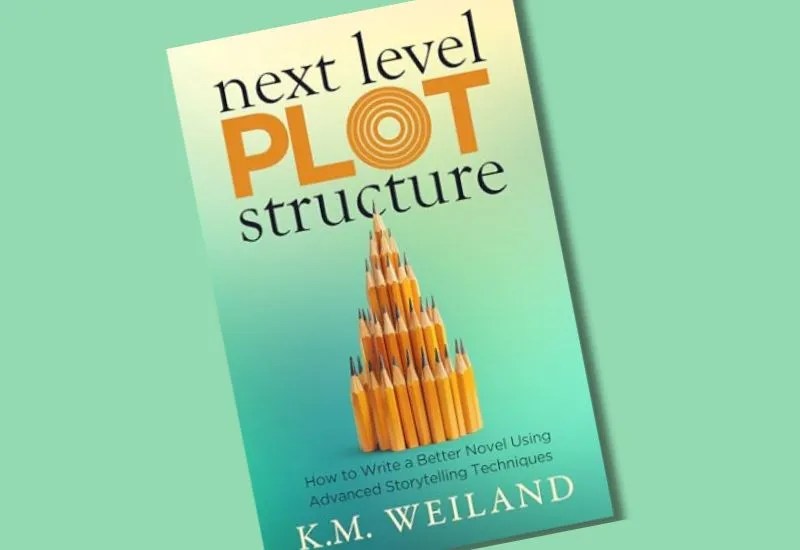
How to write better books using chiastic structure on a macro and micro level
I’m such a sucker for writing craft books! I appreciate everything that K. M. Weiland puts into the world, so when her new book came out, I grabbed it. I’d never seen a plotting book that focused heavily on chiastic structure. That’s what sold me.
Chiastic structure is an age-old technique that I recognized from the Bible, but it spans a range of literary traditions over time. It’s where the first half of the story mirrors the second half in such a way that the book has a pleasing symmetry, and the story feels complete. The midpoint, as the mirror moment (made popular by James Scott Bell) has no pair but instead mirrors itself.
I was surprised to read about how each of the plot points has a chiastic structure within itself, and how scenes have a type of symmetry to them as well. It’s helpful to look at structure like this, as a series of questions and answers or openings and closings.
This book could be a tad more relatable and the writing jazzier, but Weiland does insert a good amount of her personality into the text.
One day, I will write a novel and pour all of my knowledge into it…just kidding! For now, at least, I will just read writing craft books like the junkie I am.
“Do NOT let your boys get Snapchat when they’re older!”
My 18-year-old niece said this to me a couple of days after I finished reading this book.
“I’ve never had Snapchat,” I said, “What is it?”
She told me about her brief but potent relationship with the app that ended in January of this year when she deleted it for good. Her story (which included lots of teen drama and unwanted nude photos) reinforced a lot of the issues and concerns that Haidt highlights in this book.
Jonathan Haidt says that, starting around 2010-ish, we began to replace a play-based childhood with a phone-based childhood, and it’s had disastrous results for kids, causing an increase in anxiety and depression.
This book is a must-read for parents who don’t want their kids to have smartphones or social media (too early) but they’re not quite sure why they want this. They’re not sure how to say no. They’re not sure if it’s right to say no.
Jonathan Haidt lays out research and stats, and he also says things that, to me, are common sense and don’t require scientific backing for me to believe them. (Example: Kids today aren’t given the same level of independence or allowed to engage in the same type of risky play that their parents enjoyed at the same age, and this hasn’t kept them safer or made them braver.)
I’m not a big fan of getting the government involved to make laws that could have implications down the road that we can’t predict, but I do love his suggestions for how parents and educators can band together outside of the law to change the ether surrounding phone use at home and at school.
He says that we need to protect kids online WAY more than we are now, and conversely, allow them WAY more independence in the real world than we do now. He suggests practical ways we can do both.
Let’s have the guts to be the parents that this generation needs!
A short piece of much-needed truth in our age of selfie syndrome
I listened to this audiobook in one day, and then I turned around and listened to the last chapter again, and I’ll probably listen to it again.
My husband and I are teaching a seminar for 20-somethings next month, and the subject is “the change,” as in Christian transformation, living as a new creature, undergoing the renewal of the mind. This was beautiful food for thought in developing the seminar content.
What does it look like to live a Christ-transformed life? One HUGE indicator is that mature Christians don’t think about themselves all that much. They don’t think less of themselves. They don’t think more of themselves. They think more about God and others than they do about themselves. This, Tim Keller says, is blessed freedom. I couldn’t agree more.
We are constantly looking for signs that we are important and valuable. We live good, Christian lives in order to achieve our “righteous” merit badges. We look to others for validation—I’m reminded of the tortured Anna Karenina asking her sister-in-law, Dolly, again and again, “What do you think of me?” Keller compares this to being in a neverending courtroom, where we are on trial, and we are looking to others (or to ourselves) for a verdict, an answer to the question: Am I a good person?
Keller says we have to get out of the courtroom. How? We accept God’s verdict of us.
When we believe in Jesus as our Savior, then we are beloved children of God. That is our identity. This verdict comes before any “performance” on our part—the act of faith, the choice to believe in the gospel results in God’s final verdict on our identity and worth. We are His children, loved, and accepted. THEN the transformation happens. The verdict OUTFITS us for the performance to come, the “enduring to the end.”
We step out of the courtroom, no longer trying to prove our goodness, and we are free to stop obsessing over our self-worth and turn our precious focus upward and outward, where we find joy and freedom.
I’m intrigued by Higginbotham’s new book on the Challenger disaster, so I thought I’d try one of his earlier and shorter true-crime books. This one describes how a dude made a bomb, put it into a casino, and attempted to extort money. Why did he do it? Did he succeed? Did the bomb, you know, go off?
This was a punchy, intriguing read. I listened to the audio narrated by the author, and it was great.
Because the crime happened back in 1980, before the Internet and cell phones and such, it was fascinating to learn how this dysfunctional man (a real piece of work) got the dynamite, rigged the bomb, placed it, and communicated with authorities…back in the Stone Age. 😂
But even MORE interesting are the family dysfunction and interpersonal dynamics at play here. Nobody does this kind of thing JUST for the money. Nor does a person do it alone, with no accomplices or stooges. The WHY behind the crime was most interesting for me.
I do not like grotesque true crime, where children are abused and people are graphically dismembered. This was a great read for someone like me who enjoys exploring the psyche and motives behind crime, but who can’t stomach graphic violence.
Meet a couple of spinsters who will change your life forever and ever amen.
“Can I weep openly right now?” That’s the question I had to ask myself every time before pressing play on this audiobook. I shed many a tear into my family’s dinner as I was cooking it, into the pavement around my neighborhood as I walked, onto my clean laundry as I was folding it.
It’s been 10 years since my last reading of The Hiding Place, so I was due.
First and foremost, this book is a testament to the power of God, and it’s also a tribute to Corrie’s sister, Betsy, and her faith. This time around, I was struck by how many times Corrie described Betsy as an otherworldly being. “Who is this sister of mine?” When she prayed for her enemies, thanked God for fleas. I think this is what it means to be a new person in Christ, to have a new heart. It’s something that the unbelieving spirit of the world cannot comprehend.
Indeed, this book does not diminish the power of God. Every step of the way, Corrie demonstrates with evidence (tangible and intangible) how God gave them everything they needed to do everything He asked of them. Many times, they didn’t see His hand until after undergoing a test of faith, and only afterward did they realize He’d been at work.
I love everything about this story, and I think everyone should read it. It’s a WW2 memoir that is almost never a downer…ever! It’s edifying and uplifting while also not shying away from the horrors and atrocities.
I’m amazed by how readable and riveting the writing is.
What if you exchanged a life of freedom for one of complete bondage?
This account was devastating to read. I can’t imagine how devastating it was to live through.
The atrocities that the North Korean government committed against its people are horrific. (And it’s still happening.) Masaji had a unique perspective because he spent his childhood in Japan, so when his family moved to North Korea when he was 13, he completely understood what they’d left behind…the “other” world that was “out there.” I can only imagine how those memories tortured him (and his family).
This book shows where communism leads…eventually. It’s bad.
I will say that this account is very sad, front to back. I wish that it ended on a happier note, but it ends on an honest one. If you’re hoping for a soaring tale of hope, this isn’t it.
This was just plain fun to listen to on audio. I’m not a writer of novels, but I am a reader of them. I’m interested in why some stories work and others don’t. This book sets forth 20 plot skeletons that writers over the centuries have used as a basis for some of the most enduring stories of all time. Why do they work?
Well, they have certain elements in common. Without those elements, the plot doesn’t ring true—or it just skids off the path and into muddlement, leaving the reader confused. All of the plots, too, touch certain foundational human impulses, desires, and questions.
Ben-Hur is a revenge plot
Beauty and the Beast is a transformation plot.
Othello is a wretched excess plot.
It’s neat to look at these skeleton plots and see how different authors and writers apply them, whether unknowingly or purposefully. For example, I was watching the 1982 version of Annie with my boys, and I realized that it’s an ascension plot. More than anything else, it’s about Annie (a magnetic central character around whom everything revolves) and her rise from a poor, unloved orphan to the cherished daughter of a billionaire.
I don’t pretend like this book is the ultimate and last word on plots. It’s just interesting information to add to my foundation as a literature nerd. Since this was written back in the ’90s, it comes from a strong Western, Judeo-Christian worldview, and, therefore, it makes a lot of sense when you stand it up next to the Western canon (naturally). There are other storytelling traditions outside of this worldview, but those aren’t mentioned.
The man is fearless, brilliant, and eloquent. You can’t pooh-pooh him as a political talking head. Not when he travels, reads, listens, and fully engages with the matters that he’s chosen to care about.
I disagree with Murray on some essential things, religion for one. But I agree with him when it comes to the subject of this book.
Western culture, religion, and philosophy have contributed to some of the most significant advances in history, giving birth to the most peaceful, prosperous, and free nations the planet has ever seen.
Have westerners done wrong? Of course! Is the west above reproach? Of course not!
But Murray does a fantastic job of describing the gross double standard that exists right now. People are throwing the baby out with the bathwater where the west is concerned. Instead of valuing and preserving the good, some people find it much more convenient to say “It’s all bad” and seek to destroy and defame it wholesale.
I loved the interlude on gratitude. If you don’t read anything else in this book, read that. It touched my heart. Murray says that hatred of the west stems from a deep-seated ingratitude. You can’t tear down something you’re grateful for. We are so profoundly ungrateful for the freedom, peace, and prosperity that we enjoy in the west. Instead, we nitpick our blessings until we’re convinced that they’re shameful burdens.
There’s no doubt that Murray is angry. You can feel his anger boiling beneath his lyrical prose. The dude is mad. Some readers may be off-put by this, but I wasn’t. He’s alarmed and upset in the same way you’d be if you discovered someone in the act of trying to commit suicide. What are you doing to yourself?? Stop hurting yourself right this second!
If you can, listen to the audiobook. Douglas Murray has a beautiful voice.
I’m not writing fiction, but writing craft books have been catnip for me lately. WHY?
I love the ideas and frameworks that authors use to write fiction. It’s so interesting to me. I enjoy seeing how (and if) well-done books align with these (now iconic) story beats, and how they fall into one or more of the 10 thematic categories that she identifies.
I understand why some people strongly dislike “formulaic” books like these. I’m not a huge fan of big promises like “follow these steps and write a bestseller,” but I’m not wholly unconvinced that this beat sheet isn’t useful to writers, especially new writers. It sure is interesting, I’ll give it that.
Because I’m not an author, I feel serenely removed from this debate, watching from afar on my reader’s couch.
Why did I choose the YA version instead of the original? Because it’s newer, and I wanted to see if Brody revised any of her earlier advice. I don’t think there are any major differences.
This would make the perfect high school graduation gift for a Christian kid. This is a short, practical method to getting things done that comes from a Christian perspective. It wasn’t earth-shattering for me, but I can imagine it would be super helpful for my teenage nephews who are about to embark upon Real Life after high school.
This is my first interaction with Challies, so I don’t know him in any other context besides this book, but I liked what he had to say about centering life on loving God and serving others. We’re not getting more things done just so that we can amass wealth and accomplishments and fame. We’re trying to steward our lives in a way that will honor God because we love and revere Him, and we acknowledge that He is in charge of our plans and path.
I think this book would’ve felt more “new” if I hadn’t read Mystie Winkler’s planner book. She draws on several of his frameworks, including a weekly review. I liked the planner book a lot because it’s specifically for moms, and it felt more relevant to my situation right now.
I’m not a big app person. I do much better with paper and ink, but I can apply the general principles attached to the digital tools (Todoist, Google Calendar, and Evernote) to my paper planner. I did enjoy the section on Serve and Surprise. I like the idea of surprising people by going over and above.
And, if so, can we save it? Classicist Spenser Klavan, host of the Young Heretics podcast and co-writer of The New Jerusalem Substack, says that the West is facing five major crises. But, it has faced them before. So, let’s look to the wisdom of the past and see what we can learn from that.
Here are the five crises: 1. The crisis of reality. In a world of AI and VR, what is real life? 2. The crisis of the body. Is it okay to manipulate or deny our fleshly shells? 3. The crisis of meaning. Why look for anything deeper than the here and now? 4. The crisis of religion. If we refuse to worship God, what do we worship instead? 5. The crisis of regimes. Is democracy done?
He draws heavily on Plato, Aristotle, the Bible, and other thinkers of the past to help bring sanity to these five areas that seem to be devolving into chaos—or so riddled by controversy and conflicting viewpoints that stability and harmony seem impossible.
I’m not one to over-listen to the news or political talking heads. Nor do I have an active Twitter/X account to provide a nonstop stream of news to my phone. I’m not an expert in politics and culture, and it’s been many moons since I’ve read the ancient and classical philosophers (let alone modern ones). Having divulged that grain of salt, Klavan makes a lot of sense to me. This is no surprise given that the author’s worldview overlaps heavily with mine.
So, even though I’m probably biased beyond measure, I found this book incredibly readable and edifying. It’s edifying because Klavan’s moral soil is rich. Even though he doesn’t lean into scripture (he explains why) it’s clear that his arguments align.
The book is organized logically according to the five crises. Klavan explains each one and then offers wisdom from the past to help point us toward truth.
It’s readable because the language is beautiful and clear. Klavan takes dense material and makes it understandable (but not exactly easy).
I highly recommend listening to the audiobook. Klavan’s got a rad bass going on.