So far, I’ve enjoyed everything I’ve read by Mimi Matthews. She tends to write clean, interesting romances that aren’t irritating.
Her books are perfect for when you want to drop a romance bomb on your reading life. Romance with a capital R. Her books are decently clean. For example, in this one, there are bedroom scenes between a husband and wife, and even though they’re steamy, they’re not spicy or explicit. In fact, it’s sweet to see the marital bed depicted in a positive light.
What I’m saying is that the romantic relationship is the point of the book. There are side characters and some light subplots, but the two main love interests get the spotlight. There’s a dab of suspense and intrigue. This keeps things interesting and allows external forces to put pressure on the romance and test it.
Most of the action, however, happens internally. Our main character, Philly, is great with wounded animals. That’s why she feels drawn to Captain Heyward (which made me think of Sanditon every time I heard it). The Captian was traumatized in battle and sustained injuries that resulted in lifelong handicaps. Philly is just the girl to make him feel safe. It’s your classic Beauty and the Beast setup—the beast isn’t lovable until he is loved. Philly has a less dramatic arc. She grows stronger and more confident in the face of the girl-bullies who try to cow her, and she becomes a tad more worldly wise to wicked people who hide their true selves.
What I appreciate most about Mimi Matthews is that she doesn’t throw unbelievable or exasperating things at her lovers to keep them apart. A pet peeve of mine is when an author overuses a misunderstanding or presumption to throw an obstacle in the way of love. If the two people would just talk about it, they’d resolve it in one beat. But no, this one unspoken belief keeps them apart for 30 chapters. That gets old fast. In this book, there are many misunderstandings, but the characters clear them up quickly and move on. This is much more satisfying.
Honestly, this all makes for a solid book. It’s not the most amazing story, but it WILL hit the spot if you need to satisfy a Jane Austen craving with some quick sugar.
According to Hercule Poirot, Christmas is a natural time for murder
Family members gather from afar. Personalities clash. People bring up past offenses. Tensions run high. Should we be surprised when all this tinder catches fire? No, says the logical Belgian.
In this book, we have a houseful of family members, and it seems that one of them has murdered the patriarch. This man is not nice. We are not sad when he dies. Simeon Lee, the head of the family, takes perverse pleasure in causing his family members distress. He’s never displayed high moral character—shady business dealings, extramarital affairs, etc. Now, it’s come back to bite him. To end him.
The trope of the Evil Parent is something that I’ve seen before in Agatha Christie. It’s also similar to the setup in Knives Out.
But who did it? It’s a locked-door murder, and everyone in the house is a suspect. Who stood to benefit from the old man’s death? Who hated him the most?
To solve this one, Hercule Poirot decides to take a close look at Simeon Lee himself, insisting that the character of the deceased often leads directly to the murderer.
There are red herrings and other deceptions that keep this book moving along. In my opinion, this is one of Agatha Christie’s stronger novels. It serves up just what I hoped it would, including justice.
My only complaint is that I wish there were more Christmas-y trappings to make it more of a seasonal read.
Like many others before me, I find myself at a loss. There’s no earthly reason why this book should be interesting, but it is. It didn’t take long for me to fall into Piranesi’s narration, which is highly logical yet leaves you with more questions than answers.
This book is about a man named Piranesi who lives in a sprawling classical building complex surrounded by the ocean. The building is bursting with statues depicting all kinds of things. Its lower floors are flooded. It’s filled with birds. You can see the stars.
Piranesi calls himself a beloved child of the house. He’s content to live a rather survivalist life in this lonely place, yet he’s not unhappy. He keeps a daily journal. He meticulously maps the house. He lovingly cares for the dead bodies in the house. Twice weekly, he meets with The Other, another man who inhabits the house. The Other is on a quest for deeper and higher knowledge.
That’s the setup. I know. Weird!
Even though it may seem like this book is about nothing, it is about life. Probably? We try to make sense of where we find ourselves in the world. No matter how large or small the scope of life, we seek to understand it, document it, and sustain it. Piranesi is a master at living in the moment.
But what happens when an external force challenges what we believe to be true about the world? What happens when there is more to the world than we thought? How do we react when we realize we have been wrong, that we’ve forgotten things?
Honestly, I’m not sure what to make of this book, but it sure was an interesting foray into a non-cheesy fantasy world.
I listened to Faith Moore’s podcast series on A Christmas Carol this year and loved it. She does a great job of narrating the book as well as interjecting short “notes” to clarify what’s going on and bring out important pieces. So, reading her spinoff novel seemed like the perfect companion to the podcast.
This book reimagines Scrooge as a middle-aged workaholic woman named Karol. Unlike Scrooge, she has a family, but she has disconnected from them and isn’t interested in spending time with them. Christmas isn’t a happy time for Karol, as it causes her to remember her mother’s death and her estrangement from her sister. But she does find solace in her career as a lawyer, which is going very well.
Karol believes that her husband and kids don’t need her—they only need her to work to provide money to sustain their lifestyle. She likes the way she feels when she’s at work: in control, successful, powerful. She doesn’t like the way she feels at home: trapped, out of the loop, redundant. This leads her to where she is at the start of the book: A success at work, and a failure at home. But she doesn’t see her homemaking failures as a big deal. She’s a high-powered NYC lawyer…and that’s the very definition of success, isn’t it?
Karol calls her employees to work on Christmas Eve to handle an issue regarding a Very Important Client, but on her way to a meeting, she slips and hits her head in Rockefeller Center and ends up in the hospital—but it’s not your typical hospital. There, she has three separate encounters with the past, present, and future. These cause her to rethink her notions of success and confront the deep unhappiness that she’s been trying so hard to mask with money and makeup.
I really enjoyed this book because I’ve chosen to devote my talents and energies to professional homemaking. I’ve largely phased out of any type of money-making work. I stay at home with my kids and homeschool them. My days are dominated by parenting challenges and household chores. I have chocolate-chip banana bread in the oven as I type this book review. I’m one of those. Naturally, I enjoy reading books that reinforce my life choices.
But, I also believe that what Faith Moore is saying about finding joy is true. Investing in my husband and my kids is something I won’t regret. I may not make any money, but I save a heck of a lot of it. I know my kids inside and out, better than they know themselves. My husband and I agree that we have the best marriage of anyone we know. These are not small matters. They are what a fulfilled life is built on.
Are there days when I wish I could put my kids on the school bus and let someone else deal with them? Sure! Are there days when I die a little bit inside, knowing that I will perform grunt work from morning til night? Of course! Are there times when I look with envy at beautifully dressed women who have important jobs to run off to? Yes. But I wouldn’t trade what I have.
Let me be clear: This book isn’t saying that all women should be homemakers. It is saying that all women should prioritize the human connections in their lives over material gains. Making husbands and kids a priority (instead of an afterthought) will lead to a correct ordering of affection, which leads to joy and fulfillment. No amount of money or success can fill the void when husband and kids have grown cold and indifferent.
Some may find this message grates on them or feels too political, and it’s hard for me to offer an unbiased opinion because I agree with what this book is saying. But, if you value the home and the woman’s role in it, then I think you’ll find a lot to like in this retelling.
I read this book with my 7- and 9-year-olds for Sarah MacKenzie’s Christmas School this year. I was surprised by how much they were able to access, despite the old-fashioned language. This tale echoes through so many other stories that they’re familiar with, namely the Grinch.
I am a fan of The Muppet’s Christmas Carol movie, as well as Mickey’s Christmas Carol (I had a bootleg VHS recording of this as a kid), but I cannot abide the Jim Carrey version.
My 9-year-old and 7-year-old boys loved this fantasy series that’s loosely based on the early life of King David. In this final book, Aidan Errolson must come out of hiding in the Feechiefen to face the impending downfall of King Darrow. The only question is will Darrow take down Corenwald with him? Well, we know that Aidan won’t let that happen without a fight, and we know that he has what it takes.
This book has some of the best Dobro moments in the series. He’s such a funny character, and my boys have now incorporated a new inside-joke phrase into their repertoire: “Time to leave these neighborhoooooooods!” For whatever reason, that one stuck.
This book also has a few very touching moments that made me choke up. No spoilers.
A few thoughts on the series overall:
1. There are almost no girls in the series. My boys did not comment on this or bat an eyelash. They are boys and love reading about boys. Girl readers, though, may notice. This book contains a few girl characters—rich ladies from Tambluff, including one spirited young woman who can match Dobro stride for stride.
2. The series focuses so closely on Aiden that the worldbuilding and external plot feel rather loose. It’s rather like the first Narnia book. We don’t get a lengthy deep-dive into the lore of the land, nor do we get our specific questions answered. We just take things as they come at us. This is largely the same. Although it’s a fantasy, don’t expect the granular detail or tightly woven fabric of a series like HP.
In fact, Rogers seems to intentionally go in the opposite direction, dedicating whole chapters to tree-chopping contests, feechie ballads, and other seeming side notes. Often, these colorful scenes were favorites of my boys. They are young and always up for a laugh.
3. In case you’re wondering, as I did, how far into David’s life this series goes, it focuses on David’s early life: facing Goliath, King Saul’s paranoia, Jonathan’s friendship, and going on the run with his followers. There is no Bathsheba character nor any intentional murders. Also, it’s not a beat-for-beat retelling. It’s inspired by King David, not based on him.
A SMALL SPOILER: I will say that I find it incredibly interesting that Rogers chose to make the feechies and civilizers long-lost relatives. They both descend from the same mainland tribe. The feechies came to the island first, and the civilizers came much later—so much later that they didn’t recognize any shared history with the feechies. Far from being two separate peoples, they discover that they are, in fact, one. I find spiritual significance in this.
My boys laughed along with this one even more than the first. They thought the feechiesing was the best thing in the world. They utterly connected with the rudeswaps and wrasslin’. They thoroughly enjoyed this second installment and are ready for book three.
I thought this book had a nice, tight structure. It’s a there-and-back-again story, where Aidan’s loyalties are tested to the max. This book reflects on King David’s time in Saul’s court, when Saul fell into depression and paranoia. Thankfully, Aidan doesn’t spend the length of the novel in King Darrow’s castle. Darrow sends him on a death mission—fetch a mythical flower from the depths of the Feechiefen. Darrow hopes that Aidan will fail and never return.
But, as we know, Aidan has what it takes.
He is an aspirational figure for kids to look up to. In this book, he faces the foe of disillusionment. I was happy with the moral of the story—you can’t be happy if you refuse to live in the grace you’ve been given.
There’s no reason why I should’ve liked this book, but I did!
I think portal fantasies work well for kids. You know…Narnia. But for adults, it’s hard not to make them cheesy. In this novel (which started as a podcast series) Andrew Klavan owns up to the cheese.
The main character, Austin Lively, gets unaccountably transported from contemporary Los Angeles to a medieval fantasy kingdom. The only thing that connects the two worlds is a mysterious book. I can barely type it without cringing. It sounds so bad. But Klavan miraculously handles it in such a way that it’s not cheesy after all. He writes in first-person, and Austin’s voice is so strong, so crass, so humorous, and so typical of what you’d expect from a Hollywood hack, that the authenticity of it works.
I sped through this novel not because this is my kind of book but because Klavan is a great writer. He writes legitimately good prose. He had me hooked on the unraveling mystery. I cared about the foolish protagonist and wanted him to win despite his many flaws. I became intrigued by the layers of powerful people involved and wondered what it all meant.
Overall, this story is about a young man who is underperforming in every area of life with no incentive to better himself. How do you take someone like that and transform him into a selfless man of stout heart and right belief? From what I know of Klavan, he believes this is an actual problem in society right now. How can men become men again?
This whole book is kind of a content warning. There is a lot of foul language and violence. There are some scary images, but I’m a wuss, and I did fine. There is a fade-to-black sex scene. Women are praised for being traditionally feminine. I have no problem with this because I embrace traditional gender roles, but I can see why modern tastes may find this unpalatable.
I loved Bleak House, but I think I just might love this one more. This book is about what it means to be truly free and happy.
Amy Dorrit was born in the Marshalsea prison for debt. Her father was once a prosperous gentleman, but now he’s imprisoned for life. Amy, the youngest and smallest of her siblings, quietly and devotedly manages things so they can all survive.
One day, when Amy is 21, a 40-year-old man named Arthur Clennam comes on the scene, and he’s a friend to her and her family. He plays a key role in making a discovery that leads them out of the Marshalsea and restores all their former fortune and then some. The Dorrits go from a literal prison to a metaphorical one (London high society). Meanwhile, Clennam falls upon hard times and there’s a reversal of fortunes. But wait, there’s another twist.
Amy and Arthur’s story is just one fraction of the book. There is a huge cast of characters who are all trying to break free from something. What does it mean to be truly free in body, mind and soul? Some characters are imprisoned by expectations, by guilt, by vice, by emotion (romantic love in particular). It is so beautifully rendered and woven together. It’s far too complex to write about here, but I thoroughly enjoyed steeping in this theme for a month.
As is always the case with Charles Dickens, his antidote is Christian love. Even though Dickens was a flawed man who made a lot of mistakes, he writes so clearly about the power of Christian morals and ethics to bring true freedom and happiness.
I highly recommend the audiobook narrated by Juliet Stevenson. I don’t think I would’ve enjoyed it half so much if I’d read it in print. I also highly recommend watching the BBC miniseries first, as it’s shockingly faithful to the original.
Now, some quotes:
Regarding Mrs. Clennam: Verily, verily, travellers have seen many monstrous idols in many countries; but no human eyes have ever seen more daring, gross, and shocking images of the Divine nature than we creatures of the dust make in our own likenesses, of our own bad passions. Ch. 30
Regarding Arthur and Amy: Looking back upon his own poor story, she was its vanishing-point. Every thing in its perspective led to her innocent figure. He had travelled thousands of miles towards it; previous unquiet hopes and doubts had worked themselves out before it; it was the centre of the interest of his life; it was the termination of everything that was good and pleasant in it; beyond, there was nothing but mere waste and darkened sky. Ch 27
For we all know how we all deceive ourselves—that is to say, how people in general, our profounder selves excepted, deceive themselves—as to motives of action. Ch. 13
Be so good as to say nothing that goes beyond what is said among us. If you keep within our bounds, you cannot well be wrong. Ch. 8
It is enough that she was inspired to be something which was not what the rest were, and to be that something, different and laborious, for the sake of the rest. Inspired? Yes. Shall we speak of the inspiration of a poet or a priest, and not of the heart impelled by love and self-devotion to the lowliest work in the lowliest way of life! Ch. 7
Crushed at first by his imprisonment, he had soon found a dull relief in it. He was under lock and key; but the lock and key that kept him in, kept numbers of his troubles out. If he had been a man with strength of purpose to face those troubles and fight them, he might have broken the net that held him, or broken his heart; but being what he was, he languidly slipped into this smooth descent, and never more took one step upward. Ch. 6
What if the world continues on an artificial trajectory until there’s nothing left worth living for?
This dystopian novel is relatively quiet and thoughtful, but I was completely invested in the story and sped through in just a few days. I love the articles and resources that Peco and Ruth Gaskovski offer on Substack, so when I discovered Peco’s novel, I instantly knew I wanted to read it.
The worldbuilding here is so, so good and eerily believable. We’re in North America 300+ years in the future. The vast city of Lantua is a technologically advanced, progressive place where anything goes—that is, anything promoting self-centeredness and dependence on the state. Things like family and religion and privacy are acceptable only when controlled by the government. Couples, married or not, may have one child that is birthed in a bio bag. Body births are icky and illegal. Religion is okay as long as people don’t take it too seriously and it doesn’t usurp the almighty gods of self, safety, and state. Everyone is equal, except they’re not. The society is divided into echelons, and people move up or down depending on how well they follow the rules. Step out of line, and you may get demoted to a lower rung, where you don’t have access to the fine things enjoyed by the upper-echers. In Orwellian tradition, Big Brother is always watching, via “eyes” and drones—cameras and microphones everywhere. Don’t stress, though, they’re just here to help and keep you safe, after all.
Oh my. Can you see it?
The Benedites live in the Territories. They follow the old ways. They farm and raise their own children and go to church and worship Jesus. They, too, can be rigid and exacting. The Lantuan state sterilizes the majority of the Benedites so they don’t have too many kids and outnumber the Lantuans. (Phaoroh, anyone?) The Bennies hate forced sterilization and have managed to revolt and resist from time to time, but rumor has it that they are staging a larger uprising.
This is the backdrop. I don’t much want to comment on the characters or plot because it was SUCH a pleasure to read this book blind—without knowing a shred of what was going to happen.
Just the other day, I read this article about fertility by Peco, and it was such an enrichment to my reading of his novel. Great timing.
This book isn’t as high on action and thrills as you might expect. It doesn’t lean heavily into sci-fi, although I’d classify it as sci-fi dystopian. Instead, it asks those looming, moral questions and doesn’t apologize for it. Those of you who know your Bible will be rewarded with allusions and parallels. Those of you who know Latin (not me!) will need no translator for Bennie slang.
Do you have a kid who hates change? They will understand Lydia. She loves her home in Mulberry Glen, where she lives with a philosopher, a fairy, a cook, and a pair of mischievous twins (a young boy and girl). Why would she ever want to grow up and leave this safe, cozy place?
But, she must. Lydia must start an apprenticeship if she wants to become an herbologist one day. Lydia is like Jo March on the brink of going to New York.
But before Lydia is assigned an apprenticeship, something else happens that forces her to leave even earlier than expected and not on safe, predictable terms.
There is a Darkness that’s spreading from the forest of Tenebrae, and rumor has it that the only thing that can vanquish the darkness is a flower called Omni Res Mundi (Latin translation: “everything in the world”).
Lydia teams up with some colorful characters to accomplish her mission and (maybe) vanquish the Darkness for good.
There is a great discussion here about what it takes to beat back “the dark.” So many of us struggle with dark thoughts, depression, despair—and other people seem to be happy as clams, so why aren’t we? How do you stop those dark thoughts from spreading and taking over? This is a timely topic but one that’s as old as time.
This book offers an answer to this question, and I agree with the beautiful message. I hope that a lot of kids and young people take it to heart. It’s the truth.
To parents of sensitive kids: Even though this book ventures into the darkness, it isn’t dark, so approach it without fear.
As someone who isn’t familiar with Latin, I hope they include a translation page somewhere in the front or back matter.
I had the itch to read sci-fi earlier this month, and so I thought, “Hey, the Expanse was pretty popular, and I’ve never read anything by these authors before, so why not start with book one in their new series?”
I made it halfway through in order to give the book a chance, but then I decided to call it quits. I may go back and listen to the rest at some point, but the first half wasn’t compelling.
The premise reminded me of the story of Daniel in the Bible (not exactly, but kinda). A powerful and power-hungry galactic civilization conquers a smaller planet (not Earth) that’s populated by humans, and they only let the cream of the crop survive. They bring these people into their regime, and the humans destroy the enemy from within. It sounded good!
I think the primary reason I wasn’t engaged is because I wasn’t crazy about any of the characters except maybe Dafyd. There were so many I wasn’t sure who I was supposed to care about most. I couldn’t visualize them, and I kept confusing them at first because they didn’t have enough flavor to distinguish themselves from each other. When characters are good, I can tolerate a blah plot, but I didn’t connect with any of them here.
Also, I didn’t connect with the enemy race, the Carryx. They are loathsome, insectile creatures who don’t understand humans. They deal with their newly captured subjects via proxies that can communicate with them, sort of. It would’ve been more engaging if the enemy wasn’t so hard to understand.
Another thing. I listened on audio, and the narrator wasn’t my favorite. I read the first chapter in print before I switched to audio, and I did enjoy that first chapter. It’s possible that the narration just wasn’t my cup of tea, and that could’ve colored my experience.
You could shelve this under Christian fiction, but it wouldn’t exactly fit in with its peers there. This is a coming-of-age novel set in the ’60s. Frank, a 13-year-old boy, must come to grips with several tragedies that happen over the course of one life-changing summer. His father is a pastor, but his mother is barely a believer, and Frank must decide what he thinks about God.
Because Frank’s father is the pastor of a small town, and because the book deals with a series of tragic events, many of the characters question God, reach out to God, and fall on the mercy of God. I appreciate how beautifully this is done. Kreuger deals with this honestly, but (spoiler) the verdict falls in favor of Jesus Christ and his grace. It’s rare to find this in a dude book, and this is most definitely a dude book. Think Leif Enger.
It’s hard to discuss the plot without spoiling it. Kreuger said in an interview in the after-matter of the audiobook that he wanted to write a novel that didn’t follow the tight mystery plot pattern that he uses in his Cork O’Connor series—I’ve only read the first one in that series, and it’s good (if gritty). So, this book has a mystery element, but it’s not a classic mystery. It’s more open and fluid. Frank encounters a loss of innocence, and he must figure out how to move forward in a world where bad things happen to good people and where we can’t simply run away from our problems—because sometimes our problem is “who we are” and we can’t run from who we are.
One of the best things about this book is the wide range of men that Frank is exposed to. You’ve got bullies, drunks, wifebeaters, rich guys, preachers, homosexuals, loners, and artists—and Frank realizes that there’s more to each of these men than the stereotypes they portray to the world.
I did feel like the plot was a tad predictable. I didn’t gasp at any twists. And I felt like the characters were a tad slow to figure things out. But, the book isn’t about the plot. It’s about Frank and his family, and it’s good to know that going in.
A gentle, heartwarming tale set in the Grand Canyon
I dislike animal protagonists, so I need a compelling reason to read a book that centers on an animal. What prompted me to pick this one? 1. Because it’s set in Arizona. There are so few books set in my state. 2. The many great reviews. 3. Brighty the burro existed. I’m more interested in animal stories inspired by real-life animals. 4. It’s short, and I figured we could start and finish it during a long road trip I took with my two boys. We did!
Bright Angel is a donkey who lives in the Grand Canyon circa 1910. He befriended an old prospector who nursed him back to health after a porcupine attack. The wise prospector never tried to “own” Brighty, who is wild and spirited. But, the donkey stayed close to the prospector and carried his belongings and shared companionship with him. Brighty wanted to retain his freedom, but he also wanted friendship. The prospector allowed Brighty to have both. This resonated so deeply. Isn’t that the essence of a happy existence? Freedom and friendship!
This backdrop is where the story opens. Brighty and the prospector (called Old Timer) find a vein of copper in the Grand Canyon. This stroke of good luck is quickly followed by bad, and things go from there. The author includes historical figures, such as President Teddy Roosevelt, in the book, and this factual accuracy does result in a plot that isn’t as tight and straight as what we’re used to in modern times. But there’s a lot to like.
I loved the way the Grand Canyon and the Southwest are portrayed. We live in a part of the world where life exists in spite of the many natural elements trying to extinguish it. But Henry does a lovely job of highlighting the many beauties of the high desert.
Overall, this book was a GREAT experience for us. But I had low expectations because, you know, animal protagonist. I wouldn’t want anyone to go into this book with high expectations. It’s relatively quiet and meandering in parts. But it’s a sweet, comfortable book.
I must say that narrator John McDonough is pitch-perfect. He sounds like a lively grandpa telling the story. His cowboy twang added a fun aspect to the dialogue.
This quick Christmas romance brings second-chance love with You’ve Got Mail vibes
It’s not often you read a holiday rom-com about an estranged wife and husband getting back together, but that’s what happens here. Our protagonist, Fern Gale, is the town recluse. She lives in a gorgeous house in a small town, but ever since her mom died four years ago (and her husband abandoned her) she has been filling it with antiques with vague notions of selling them at some point. Maybe. She’s aimless and alone.
When a pipe freezes and bursts in her historic house, she calls the only person who knows where the water shut-off is buried under the new-fallen snow—her ex. They haven’t spoken in four years. Now what?
This is a simple, sweet book that will make you smile and get you into the holiday spirit. The only thing I wanted to know more about is why Fern’s husband left and stayed MIA for so long. I understand generally why, but I wanted there to be a bigger “last straw” that sent him packing and justified the years-long estrangement.
This middle-grade fantasy feels a lot like The Giver (one of my all-time favorites). Our 12-year-old protagonist, Aster Temple, lives in a tightly controlled and enclosed community called Hargrove, where people live in fear of getting caught. Doing what? Dreaming.
In Aster’s world, having dreams is a crime that gets you banished. Aster’s dad is an inspector who arrests and banishes dreamers through the Red Door, a magical portal around which the settlement is built. And Aster is a dreamer.
There you’ve got the premise.
I loved Aster’s emotional progression over the course of the novel. She starts as a pretender—it’s how she survives. She pretends to be confident and innocent, two things she isn’t. Inside, she’s weak and ready to do anything to save herself from discovery, from banishment, and from harm. She ends the novel willing to sacrifice her own safety to help others. She discovers peace and humility.
This is a refreshing take on the super-kid trope. I didn’t get the impression that Aster reaches deep within herself to find the strength to vanquish her foe. She does it because she is thinking more about others than herself. This is one of the book’s great strengths.
There are a few things that I wish were more fleshed out: I wish the book dove deeper into why dreamers are persecuted. I wish we knew where the Red Door came from. What’s the logic behind what’s behind the Red Door? (Yes, you DO find out!)
Overall, this is a great book for the younger side of the middle-grade age spread. Kids who aren’t quite ready for The Giver.
I enjoyed this book more than The Green Ember and On the Edge of the Dark Sea of Darkness. This swampy fantasy was just as entertaining for me as it was for my 7- and 9-year-old boys. After we finished this one, they immediately asked if we could start book two in the series.
I must say this upfront. I obtained the NEW, redesigned hardbacks. They are gorgeous. The cover is lush. The interior black-line illustrations are wonderful. This new edition is worth buying in print, just FYI.
This is a middle-grade retelling of the story of King David. Aiden Errolson is the David character, and when this book opens, he’s 13 (I could be wrong). He’s the youngest son of a lord, but he spends most of his days tending sheep. He longs for adventure and greatness. But…when Aiden has greatness thrust upon him, it doesn’t look or feel as grand as he dreamed. But, as the feechies say, Aiden has what it takes.
Ultimately, this is a story about having what it takes. It’s aspirational for kids. Can they rise to the challenges that everyday life throws at them? Aiden’s example can inspire them to do so. Aiden is flawed, but he’s also heroic and worth looking up to.
This book parallels David’s early life and culminates in the defeat of a giant and the thwarting of an invading enemy. (Just in case you want to know the basic roadmap.) But, there’s a lot more here than a beat-by-beat retelling. The feechiefolk add a lot of color and humor, and I’m interested to see what role they end up playing in the trilogy.
Overall, I think this is an amazing book for young readers, and we’re already a handful of chapters into the second book and enjoying it just as much.
I love the story behind why Charlotte wrote this book.
Her son was scared of thunderstorms. Apparently, they’re intense in Oklahoma! To help calm him through a storm, Charlotte told him a story—one where the thunder, hail, lightning, and wind came from trucks working in the clouds.
Being an avid lover of diggers, dozers, and the like, this idea helped him so much.
Charlotte decided to put her story into a picture book—one that honors God, who loves us and protects us through all of life’s storms, turning them around into something beautiful.
Like all good toddler books, this one is loaded with onomatopoeia and fun sounds to make together.
The last page is perfect—I don’t want to spoil it. Go read it!
What’s the deal with Agatha Christie and train murders?
This one was fun! I love how Hercule Poirot books include similar elements, yet they all unfold somewhat differently—always with Poirot’s big reveal at the end. This isn’t on Agatha Christie’s top shelf of best books, but it might be on the second shelf down. I thought it was a jolly good time.
This one starts with a series of character intros, setting all the pieces on the chessboard. Then, crime most foul is committed. Even though the title mentions the blue train, this isn’t a locked-door mystery like Orient Express. It’s much more fluid than that, with characters coming and going to and fro in different settings. That may appeal to some readers who get claustrophobic in tight literary spaces.
There were a lot of characters coming and going, and I will say that I did get them confused from time to time listening on audio. But the cast size isn’t bigger than your average Poirot book.
I will say that I had a lot of theories about “who did it,” but none of them were right. I can’t be sure, but I believe this book may reference other Poirot mysteries, as the Belgian detective reconnects with several of his past contacts. If that’s true, then Christie buffs may have an advantage in solving the case, but, on my own, I was way off.
Beautifully written detective novel with a stiff upper lip
This detective story from the early 20th century is not cozy. Not hard-boiled, either. It’s old-fashioned, but not theatrical.
The centerpiece is detective Alan Grant of Scotland Yard. He’s young, handsome, and not like a police officer at all. He’s not what you’d call a “character” in the same way that Poirot, Wimsey, Marple, and Holmes are characters with distinctive quirks and traits—sometimes unbelievable ones. Grant is vanilla in comparison.
This book is beautifully written, with a lot of attention to detail and emotional nuance. But, as far as character and plot, it was just okay. I did get a little bored, truth be told.
The inciting incident is fantastic. A queue of people is waiting outside a London theater to see the final performance of a beloved London actress before she departs for America. I imagine it to feel something like waiting for a Disneyland parade to start. People are squished up next to each other. Vendors are selling stuff. Street performers are doing their thing. When the line finally starts to move, a man drops to the ground. He’s been knifed through the heart! In plain sight of all those people?!?
From there, things proceed in a relatively unremarkable way. Grant is polite and logical, and he collects clues that all point to a certain suspect, yet, in his gut (he calls it his imagination) he doesn’t believe the man is guilty. He’s got lots of proof that points to this guy, but he finds himself with a (rather womanlike) gut feeling…can he find proof that this guy isn’t the murderer?
This is all good, but the execution could’ve been more exciting for my taste. I enjoy detective stories with lots of color. I don’t want to say anything about the outcome because I don’t want to spoil anything, but I do have opinions about how it wrapped up. I guess that’s better than NO opinions, right?
This was solid Christian historical fiction with a heavy helping of romance. You’ll like this book if you enjoy Francine Rivers.
This book is titled The Pesant King, referring to Cyrus, the historical leader. But the book isn’t about him as much as it’s about a young Jewish woman and a half-Jewish, half-Gentile young man and the people associated with them. They find themselves wrapped up in the warring of nations, and they do great deeds to influence the outcomes. Not in the background but very much in the forefront, they fall in love.
Like I said, this was solid. I enjoyed it, and there was plenty of action. I wasn’t crazy about it. I feel like it might’ve been a good book at the wrong time for me. I did feel like the book needed one more editing pass. Just a few nuances of wording, repeated words, etc. that jarred me.
How big of a role does the romance play? Big. It’s not spicy or distasteful at all, but it’s the driving force behind the story for sure. The good news is that there’s a lot going on in the background behind the romance—plenty to keep things interesting!
I read this one to my boys (ages 7 and 9) to enrich our studies of Ancient Egypt. They enjoyed it, although they did get a tad impatient with Ranofer’s daydreaming and anxiety. Ranofer really does remind me of Hamlet. He spends 90 percent of the novel overthinking things, and then suddenly takes dramatic action in the last three chapters. Haha.
Ranofer is an orphan who dreams of becoming a goldsmith in old Egypt. Ranofer lives with his half-brother, Gebu, who is a violent, mean-mouthed, tight-fisted terror. And, as it turns out, he’s also a thief. Ranofer spends most of the book simply trying to get out from under Gebu’s thumb.
Ranofer is a true victim, yet he refuses to act like one, which I really liked. He’s determined to change his life for the better, even though he falls into fits of inertia and even depression (of a sort). And that’s what makes him so relatable. He’s not a bright, chipper, slick-talking Tom Sawyer-type kid. He’s a child who once knew love, who had plenty to eat, and who had prospects for his future—and he’s now starved of all three. He finds two unlikely friends who keep him from despair.
I was impressed by how much suspense and anxiety I felt for Ranofer’s wellbeing, even though not much happens to him for 3/4 of the book. The last, oh, three chapters are a wonderful, speedy rollercoaster ride, and they leave you feeling a sense of great satisfaction (after having watched so much suffering and, frankly, dilly-dallying for most of the book).
This book has a lot of atmosphere, really evoking a strong sense of the historical time period and place (Thebes, the City of the Dead). You learn a lot about what it was like to be an artisan’s apprentice in these times. Hopefully, it’ll inspire kids with lots of gratitude for their amazing parents who love them so. 😉
I was surprised by how rich the language is. Lots of rigorous vocab for kids.
My sister-in-law is a huge Terri Blackstock fan, and I remember when she told me about this series after she first read it years ago. The premise is fantastic. One day, electricity doesn’t work. Nothing electric/electronic works. Planes fall out of the sky. Cars die on the road. All the lights go out. City water pumps fail. Generators won’t operate.
What would happen to the average American if an outage like that went on…indefinitely?
The Branning family is going to find out. This book is the first of four, and it focuses primarily on Deni Branning, the oldest daughter in a family of four kids. She is home from college just long enough to plan her wedding to an aspiring politician in D.C. She is on the fast track to a job in broadcast journalism. Her future looks bright. Until the lights go out. She’s stuck at home in Alabama with no way to communicate with her fiancee.
It’s not long before the Brannings find themselves hauling lake water to their house, catching fish to eat, and saving half their trash and composting the rest. Their lives change drastically.
Their quiet, affluent neighborhood is rocked when one of the families is found murdered in their home. Who is the killer? Everyone starts suspecting everyone else, and emotions run high.
This is a Christian novel, so the Brannings have to face the fact that they are Christians in name only, and not practice (both inner and outer). The family chooses to rely on God to provide and guide. The Jesus aspect is tastefully done, not cringey or contrived.
Deni escalates the conflict with some truly dumb choices, which bring her and her family close to peril.
This was a great book—perfect for anyone who enjoys Christian mystery-thriller.
I’m walking away from this book not knowing exactly what just happened or how I feel about it. It’s gorgeously written, as I knew it would be, lyrical and emotional. Everything in it feels both small and concrete but also large and allegorical at the same time.
The characters are strong. Rainy is our Orphean narrator, feeling inadequate to his storytelling task. Lark personifies purity of heart and generosity of spirit. You have standout supporting cast members, Kellan, Sol, and Werrick (and Flower if you count the sailboat as a character), but the third-tier folks kind of blended together for me into a tapestry.
Because I listened on audio, and it was SLOW going (not sure exactly why), I think I lost a lot. I may have been more attentive if I’d read this in print, and therefore come to a more cohesive understanding of the story.
Enger takes his time getting started, laying several pieces on the table, and then he does a nice job of smashing everything so that Rainy is forced to leave his normal world behind and venture on a sailboat onto unpredictable Lake Superior.
The book’s middle could’ve meandered if not for Werrick’s pursuit, which kept things moving along. Rainy’s unpredictable journey had that familiar episodic feel to it, the way Greek myth structures itself (and TV series). The setting is a near-future U.S. that has fallen into a soft yet terrifyingly believable dystopia, where citizens have been stripped of the safety and plenty that we are taking for granted at this very moment. I thought Enger did a fantastic job of upping the stakes with each of Rainy’s encounters. The plot was like a fist closing on the poor man. And I did like the ending.
Here’s where I’m not sure I’m smart enough for this book: The message. What is this book saying? I’m honestly not quite sure. The rich get richer and start doing immoral experiments on the poor to create compliance drugs in order to quell rebellion…is this a critique of capitalism or socialism or both? Or is it concerned with neither and none?
In the story world, the Christian church has been weaponized against the good-hearted, and those who possess Bibles are usually villains. There are allusions to the scribes and Pharisees vs. the disciples, but it was all rather muddled, I wasn’t quite sure what Enger was saying about the actual gospel, except that his heroes are the poor, meek, mourning, and persecuted.
It was a good book, very beautiful, but I found myself walking away with more confusion than I thought I would. In a way, it’s good because I will think about this book more than I would’ve if it weren’t so difficult to pin down. And that, in many respects, is what makes a worthy read.
What kid wouldn’t be fascinated by the idea of a whipping boy?
My boys, at ages 9 and 7, loved it. This was the perfect tiny book to slip in right before the start of the homeschool year. Plus, lots of good vocab.
I’m giving this book a lot of stars, but it’s not the end-all, be-all in children’s literature. Still, I loved the morality tale it presents.
We’ve got two main characters, Prince Brat, a terribly spoiled royal child. Then, we’ve got Jemmy, his whipping boy. Whenever Prince Brat gets in trouble, Jemmy gets a whipping (because it’s against the law to lay a hand on a princely hide.) Of course, this is unjust, and kids can see that right away.
In the dead of night, Prince Brat decides to run away because he’s “bored.” He commands Jemmy to go with him. They are terrible runaways and get kidnapped immediately by two highwaymen who stink of garlic. They meet a girl with a dancing bear and a potato seller and a rat catcher, and it’s all good fun in medieval times.
There’s a hearty moral takeaway and plenty of vocabulary words tucked into the narrative and strong historical flavor. But it’s mostly a growing-up / unlikely friendship story that I think will appeal to my boys when they’re a tad older.
If you love Hallmark (or GAF) movies, then you’ll adore this short, sweet book. Blackstock uses dual narrators. We’ve got Finn, the crabby cabby (a cab driver with a bad attitude) and Sydney the stressed-out lawyer who needs to win a no-win case in order to keep her job. No pressure, Syd.
So, fun fact. In her author’s note, Blackstock describes how she was sitting in the waiting room at her actual doctor’s office when a man wheeled in an elderly lady and then headed toward the door. She asked if he was just going to leave her, and he responded: “Lady, I’m just the cab driver.” That was her inspiration for this book.
Finn gets a call to take elderly and disoriented Callie to the doctor. Who hires a cab to take Grammy to her appt?? Well, it turns out that Sydney does—on a day when she must attend an important work meeting or risk getting fired. That gets the ball rolling, and it’s sweet as figgy pudding front to back.
Callie is spicy and determined to get her way, no matter how sick she is. Finn is prickly on the outside and jello on the inside. Sydney looks like a successful attorney, but she’s broke and hanging on by a thread.
Worldview means a LOT to me when I’m reading a light book like this one, especially a romance. Why read a candy book if the author is saying things about life and love that you can’t stand? I can tell that Blackstock and I share a lot of the same beliefs, and it’s great to see those reflected here. I didn’t have to cringe at anything…you might, but I didn’t. There are a few moments that some people will find politically incorrect, but I actually agree with the author on most things, so I, uh, mentally high-fived her when I read those bits.
Blackstock is a Christian author, but this book does a great job of not getting preachy. There is no contrived altar call moment. We see both Finn and Sydney rethink their spiritual lives, going from dormancy to just waking up. They are on the brink of starting something good with Jesus, but the book isn’t about that. It’s a side effect of their interactions with Callie.
More twists and turns than a cinnamon roll, and a masterpiece of suspense
This book has the “train wreck” quality, where every scene has you biting your nails, saying oh no, oh no, oh no. And it’s not because it’s high on action. In fact, most of the action takes place in relatively serene settings indoors, such as parlor rooms, dining rooms, and bedrooms. People talking, with only one fist-punch that I can remember. But it’s the escalation that had me hooked, hoping for a good outcome for the shy, insecure narrator.
This book is carefully crafted, swathed in atmosphere, and bursting with symbols and meaningful details. It’s a literary banquet. It’s hard to review the book without spoiling anything.
For a long time, I thought this book might be too scary for me. I thought it was more of a ghost story with paranormal whatsits flying around, but no. Even though there are eerie aspects, it wasn’t scary. And if I wasn’t scared, then nobody gonna be scared because I’m a wuss.
Even though this is a rather slim review (to avoid spoilers) you can grab my Rebecca book club guide and get everything you need to enjoy this classic.
This book is set in a mid-century modern Great Britain. So, think cars, cigarettes, socialites, mobsters, schoolboys, and landline telephones. It’s oh-so nostalgic and gritty. The book’s cover has more of a middle-grade vibe to it, but this book falls squarely into YA.
What makes this prosaic world magical? There are two brands of magic in Kazanjian’s alternate history: Alchemy and Illata. Some people are born with an Illata, which can be anything from the ability to unlock doors to the ability to cut off someone’s air supply. You can’t control what Illata you have or if you have one at all. Alchemy is learned magic, something that non-Illata-possessors practice at school and learn from teachers, but it’s a lot more difficult to master than Hogwarts-style magic. And schools are expensive, so Alchemy tends to be the magic of the rich.
I must say that I was completely charmed by the book’s ether. I loved the seedy underlord’s domain and the corrupt upper crust and the powerless kids caught in between. It felt very much like those hard-boiled detective novels, where things could go sideways at any moment.
The plot was simple and moderately paced. It may have benefitted from a faster pace and more subplots, but I will say that the climax of the book was “big” enough to be satisfying.
I’m not sure if this book is the first in a series, but it ended on somewhat of an unfinished note, with the core cast of characters returning (sort of) back where they started with a new goal. I’d love to know if Owl’s Nest has requested a sequel for this one, because I’m here for it.
There is no romance in this book, as is commonly expected in YA, just friendship. There is no gross violence, and there may have been a cuss word here or there, but there may not have been. There is adventure-style peril that doesn’t venture into the gory or morbid.
This book makes sense when you view it as a modern fable
So, my boys requested this book after watching the movie, and we devoured this cinematic little morsel ASAP. I considered labeling this one “magical realism” but it’s not really. There’s the element of destiny, fate, and cosmic what-have-you, and this is something that I usually dislike. I don’t like vague spiritual messages that confuse kids. But there’s something about Holes that feels different. I decided that I’d approach it like a modern fable or folk tale, and it clicked into place in my mind.
The Yelnats family is cursed with unluckiness. They can’t catch a break. For Stanley Yelnats the fourth, his un-luck lands him at Camp Green Lake, a reformatory for delinquent boys, where they have to dig holes in the hot sun as penance for their crimes. But, Camp Green Lake isn’t what it seems to be, and the boys aren’t digging holes to build character—they’re looking for something.
Two storylines from the past weave into Stanley’s present-day tale. There’s the story of Stanley’s great-great-grandfather, who brought the curse upon his household by breaking a promise to Madame Zeroni, a sharp-witted witch-doctor-y character.
Then, you’ve got the story of Kissin’ Kate Barlow, a famous outlaw who once robbed Stanley’s great-grandfather and left him for dead in the Texas desert. But his grandfather survived somehow—even he’s a bit fuzzy on the details.
I think the intertwining storylines and the no-detail-left-behind nature of how it all comes together hits me right in my literary heart. And it’s what makes the whole thing feel like a folk tale. It couldn’t possibly happen, but tell the story anyway because there’s truth in there.
But, this book isn’t set in a fantasy world. It’s set in modern times, so what is it trying to say? It is, I confess, a tad muddled, but I believe it’s telling kids that if they try to do what’s right, God will work all things together for good. Now, don’t mistake me, God as Creator is not mentioned, even though one of the pivotal locations in the book is named God’s Thumb, and it turns out to be an oasis of saving grace. There are elements of the story that point to a bigger plan than what we can see in a single lifetime. This is interesting.
The book is overflowing with fantastic characters, funny dialogue, and high-drama scenes. We really enjoyed it.
Well, Andrew Klavan co-authors one of my all-time favorite Substacks (The New Jerusalem), and I’ve listened to him on podcasts and interviews, and I knew that he was a novelist. But I wasn’t quite sure where to start with his fiction. Audible helped me by offering this entry point as part of the Plus Catalog.
This is the first in a detective series featuring Cameron Winter, a shadowy man who is both lethal and literary. He has killed people in his earlier days (military? Spy work? We’re not sure), but now he’s a university English prof. Okay, I’m in!
This book introduces us to the classically handsome (and classically read) Cameron, but it leaves a lot of unanswered questions about who he is and what haunts him from his past. He’s lethal. He’s cool under pressure. But he’s also carrying some serious emotional baggage. He has what he calls “a strange habit of mind” in which he clears his head, opens himself to empathy, and then allows all of the pieces of whatever puzzle he’s trying to solve fall into place, and they just do. This “gift/habit” is mostly a mystery.
An old friend asks Cameron for a favor. Can he help her with a murder case? Ex-military boyfriend kills girlfriend in a jealous rage and then confesses to the crime. Nothing to solve. But the facts don’t add up. Something’s off. So, Cameron starts sniffing around.
This is a short book that does a great job of balancing plot and character. You get a handful of plot twists, but there’s a wide range to the cast, and nobody feels like a cardboard cutout. I’m here for book two!
I can honestly say that I’ve never read a fantasy world quite like this one. The planet of Lyra never experiences day. There is only night, where the moon, called Selene, provides some light, and then Darknight, a pitch-blackness that’s dominated by the Void, an evil blight that is slowly devouring Lyra.
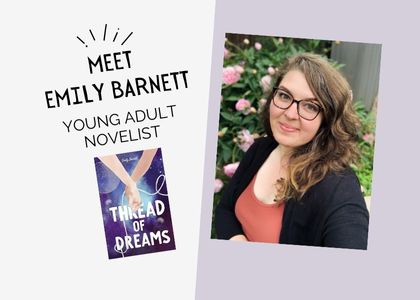
Lyra is a moonlit planet. Think glowing mushrooms. Floating jellyfish. Foxfire dust. Barnett has dreamed up a literal “dream” world that evokes a sense of glittering night, without feeling “dark” as in evil.
Lyrians are trying to heal the Void by harvesting magical threads from human dreams. Nova, our protagonist, is a young harvester, and one day, she meets a boy in a dream who recognizes her. He shouldn’t even see or sense her presence. But he knows her name!
This is the entry point into Thread of Dreams. I will say that there’s a decently steep learning curve when it comes to this fantasy universe, but the author does a great job of sprinkling the world-building throughout the book, helping you along. But there were times when I forgot what a certain thing was…maybe a glossary for the second edition?
I loved the character dynamics. Nova has an older sister, Cally, who has taken care of her since their parents died when they were kids. The bond of sisterhood is strong with this one. There is a core group of young people who must do great deeds to help save Lyra. I don’t want to spoil anything. All I’m trying to say is that there is a nice plot-character balance here.
You’ll love this if you want a YA fantasy that includes adventure and romance but that doesn’t involve graphic violence, sex, or profanity. There IS romance here, and Nova is pretty young, just thirteen when the book starts, but she ages to sixteen (if I’m remembering right) by the end. I feel that this is a nice choice if you have a teen girl who is hankering after romantic books but you don’t want her to read anything icky.
Meet the Author, Emily Barnett Check out the interview I did with Emily over on Library Binding.
Opposites attract. Big time. Romance Above All Else.
Oh, Mimi Matthews! She’s one of the queens of period romance. This is NOT what I’d call a naughty little nugget—it was clean—but the romance was laid thick.
I picked it because I needed a quick win after The Shell Seekers, and this came free with Audible Plus.
I will say this. The book is short, and it gets straight to the point. “You here for romance?” Mimi asks. You nod enthusiastically! She doesn’t make you wait even one page to get things started. Hero and heroine meet right away, and it’s off to the races from there. It’s one neat little package.
Besides romance, there’s not much here. Both Valentine (heroine) and St. Ashton (hero) have personal issues to deal with, but they play second fiddle to the romance.
Valentine is a vicar’s daughter, and she’s sweet and innocent, but she also has a blurry past. St. Ashton is a notorious ladies’ man with dubious morals. The morals praised by the book are (by and large) good. Some characters behave badly, but this is never condoned. I was happy with the standards the book set for female-male relationships and what’s okay and not.
How spicy is this, exactly? It’s a closed-door romance with 3/5 jalapeno peppers worth of spice. But I also wouldn’t call it chaste. There’s closeness and kissing, and a lot of it. Okay for a teenager? Yes, an older teen. How cringey is it? I’d say 3/5 on the cheese scale. One of the author’s strengths is that she can write these crazy romances without making you feel foolish for reading them.
A reimagining of The Little Mermaid that’s worth finishing all the way to the end
This is a romantic YA retelling of The Little Mermaid, with a gender reversal. The first half of the book was a tad slow for me, but the second half sped nicely along.
In the original HCA story, the little mermaid is a girl, and she falls in love with a human prince. In this retelling, it’s a merman and a human princess. The author adds some backstory. There was a war between the people of the deep and the people of the land, and in order to restore peace, the people of the air imposed a “silence.” No mer-person can break the surface without perishing, and any human who plunges into the ocean risks getting pulled below and drowned.
So, how are our two kids going to fall in love? Well, the first half of the book answers that question, and the second half depicts everything in the world trying to tear them apart. Hoyle does a great job of keeping the stakes high, which is important because the plot points closely follow HCA’s, so most of us have a good guess as to what happens next. With much higher stakes and a much sweeter romance than in the original, this story is actually more entertaining.
Hoyle threw in some great plot twists in the second half that left me so glad that I finished! I was a tad under the weather when I was reading the first half, so it was hard for me to concentrate and stay awake…mostly due to congestion and fatigue, lol. But I’m glad I pushed through because I read the second half in a single night. Yee-ah.
Wow, this was long. Too long. I bought the audiobook a while back when Chirp offered it on sale, and when I saw that Haley Atwell narrated it, I was sold. Atwell is a British actress, and her voice was spot-on perfect for this story. I loved her performance. I wish I could say the same for the story.
The positives:
This book feels luxurious and lush, so if you want to revel in sights, sounds, smells, and textures, this book delivers big-time. The descriptions suck you in, and before you know it, you’re physically experiencing another time and place. This is Pilcher’s strength, nay, superpower. She is a gorgeous writer. The protagonist, Penelope, even discusses the concept of “luxury” near the end of the book, and there’s this thematic question of luxury vs. comfort vs. privation, both physically and emotionally, and this was a discussion that I can appreciate.
The book is character-driven, and there is a colorful mix of characters. By far, the best mix is Penelope and her adult children, with whom she doesn’t connect. This discord makes the scenes between Penelope and her kids the best of the book. It seems like everyone else gets along too well…sees things similarly…and this was too serene for so long a book. For example, when Penelope discovers she’s going to have a baby out of wedlock, everyone in her life is incredibly supportive. It would’ve been much more interesting if someone, anyone, had put up some fireworks—at least there would’ve opened the door for a nuanced picture of Penelope’s predicament. But overall, the characters are good.
The negatives:
There are so many intertwining storylines that it’s hard to know what you’re supposed to care about. This book reminds me of Anna Karenina—a deep dive into the interpersonal relationships and inner lives of a handful of people at a specific place and time in history. That’s exactly what The Shell Seekers is. But, like Anna Karenina, the plot is meandering and slow. Pilcher slows WAY down, describing things in such minute detail that I got distracted and a little impatient. Why does this matter? She’s moving so slowly, it’s got to have some significance…but it doesn’t.
Also, this is an adultery story. I cannot express how much I dislike adultery stories. And this one largely condones the adultery. Most of the characters give the adulterous relationship a huge thumbs-up. This robbed the story of the conflict inherent in such morally fraught actions, nor does it challenge the reader to think about something like adultery from many angles (like Anna Karenina does).
At the end of the day, what frustrated me most was that I couldn’t condone the morals that the story praises, by and large. The writing is 5 stars, but the story was much more like 2, which evens out to three. So, there you go.
Content warnings: Characters commit adultery and have sex outside of marriage, and this is largely condoned. Nothing is graphically portrayed, and the romance is tastefully written, but morally disappointing.
Hertz is a screen-addicted kid who must endure a tech detox
THIS BOOK TAKES PLACE IN MY TOWN! The reason this is so incredibly exciting is that I live in a TINY town at the top of a mountain in Arizona. A town that nobody outside of the state knows about, and even inside the state, it’s iffy. When I read the book blurb and saw that this story takes place in Show Low, Arizona, my jaw dropped, and I immediately bought a copy.
This book is so much FUN! It’s a novel in verse, so any middle-grader can get through it in no time flat. Plus, it deals with an issue that most kids struggle with: screen addiction.
Hertz is always on a screen of some kind. He can’t live without a phone and access to his gaming devices. The internet? Required for life. So, when he’s forced to spend the summer with his great-uncle in the tiny town of Show Low, he is devastated to discover that he’s living in a trailer park with no Wi-Fi and not even a TV.
Of course, Hertz learns that there’s more to life than screens and their snazzy, swift distractions. He makes friends (and enemies) and learns how to live an analog existence—and like it.I love the theme, and I enjoyed the free-verse format. Lots of fun play on words and vivid imagery.
Is the book faithful to the real-life location? I thought so! Purvis does a great job of portraying the quirky local businesses that we have. I can see the pancake house as a sort of Darbi’s. The description of the Chamber of Commerce is spot on. And I love Pops. He’s an overly patriotic elder, which we have in spades ’round here—we COVER the mountain in American flags for all the patriotic holidays. If you don’t believe me, just visit on July 4. We have our share of shady pawn shops, too, although they’re far outnumbered by dollar stores. We have more dollar stores and thrift stores per capita than anywhere else I’ve ever been.
On the flip side, our cops are mostly nice, and we don’t host an annual scavenger hunt, even though we totally should.
Disclaimer. I don’t actually live in Show Low. I’m in Lakeside. (Not Pinetop either.) If you live here, this is an important distinction, but if you don’t live here, it makes no difference whatsoever.
Mr. Wonka and Charlie meet aliens and fool with vitamins
Regrettably, my boys wanted to read this after having so much fun with the first installment. This book, however, got tiresome fast. My two little boys thought it was fantastic, but I couldn’t wait for it to be over.
There isn’t much here except cheap laughs. The book reads like two separate short stories. You’ve got the first part of the book, which takes place in outer space, and the second part, where three of Charlie’s grandparents take Wonka vitamins, which make them grow younger and then older by turns.
The book portrays adults behaving like idiots. The President of the U.S. and everyone in the White House are lunatics (and so politically incorrect that even I was cringing, and I love when things are politically incorrect). The astronauts aren’t the brightest bulbs, either. And Charlie’s grandparents act like the worst kind of selfish children.
Chocolate Factory had a sense of cohesion, with each spoiled child getting what was coming to them…we know this is how it’ll play out, and it’s satisfying to see, in a sense, because we know it’s the point. But this book feels so disjointed, like there’s nothing holding it together as a connected narrative. There are no character arcs. Very few lessons learned.
It’s slapstick but has few redeeming qualities. I think you can skip it for sure.
Content warnings: If you can’t roll with stereotypes, then don’t read this.
If you want something done right, you’ve got to do it yourself—even if that something is revenge
Yippie-i-oh, it’s a western. Here’s the story of 14-year-old Mattie Ross, a precocious and unflinching girl who is bent on avenging her father’s blood.
She hires Marshal Rooster Cogburn to track down her daddy’s killer—because he’s a “shoot first, ask questions later” type guy. Ranger LaBoeuf also wants to track down the killer to collect some big-time reward money. The three of them journey on horseback into the Wild West in pursuit of the outlaw.
Why is this a classic? The characters. The mix is pure joy. Mattie is sharp-tongued and shrewd, and she has more grit than anyone. Rooster is an immoral drunk, but he discharges his duty where Mattie is concerned, and he has a (non-icky) soft spot for her, due to her spunk. LaBoeuf is a dainty braggart who shows himself worthy of his own high praise—coming through in the clutch.
Everyone is a complex, contradictory mix of good and bad, and when you throw them together—SPARKS.
Mattie’s verbal fencing is the best, and her inner monologue is just as entertaining. This girl is a Piece Of Work, and it’s fun to watch her doggedly badger people into doing what she wants and how she’s determined to have her way in every particular. But she’s not a machine or a rock—she’s soft in her own way. In many respects, this is a coming-of-age story that takes the shape of a quest.
I listened to the audiobook read by novelist Donna Tartt, and it was good. The Jeff Bridges film is perfection and quite faithful to the text!
Content warnings: There is much talk of killing, shooting, drinking, and gambling, but we don’t see too much of this action on stage. There is PG-13 action-related violence. There is surprisingly little profanity and almost zero sex in this book.
It’s the year 2025, and the bloodshot eyes of the U.S. are glued to screens…
If there is one book genre that I actively avoid, it’s horror. I’ve never read a Stephen King novel in my life. TOO SCARY.
But, when I stumbled across this thriller written under his pen name for Signet, I thought…okay, I can probably do it.
Stephen King is skilled and prolific. I wanted to read him, and this seemed like my best shot of not being scarred for life.
This book was published the year I was born, and it portrays the year 2025—next year, at the time of this review.
In King’s dystopia, the divide between the “haves” and “have nots” in the U.S. has grown into a chasm. Every home is required by law to contain (get this) a Free-Vee. (I have a similarly named app on my television.) Programming is dominated by reality TV—game shows in which people compete in all manner of deadly games in hopes of winning prize money. Contestants are largely comprised of the have-nots.
Our protagonist, Richard, is one such contestant, driven to apply for TV so that he can earn money to buy real medicine for his baby, who is sick with the flu.
Because he’s smart, Richard gets picked for the highest-rated show on TV, The Running Man. Here’s the game: Richard runs for his life, and Hunters try to kill him. He earns money for every hour he stays alive. Stay alive for 30 days, and you win. Nobody has lasted more than eight days.
Sound like the Hunger Games? Yep.
The ending is hauntingly reminiscent of something that ended up happening in real life nearly 20 years after this book rolled off the press.
It’s crazy how many of King’s presentiments have come to pass. The book’s government is irreparably corrupt, and the networks are out for nothing but profit. Today, don’t we feel the same way about Washington and Silicon Valley? People are doping themselves to avoid reality—with entertainment and pot, whatever you can afford. Sound familiar? Everything from the air to the food is polluted. Uncanny.
Content warnings: The entire book is a content warning. There’s foul/offensive language with no filters whatsoever. The book mentions every vice you can imagine, although there’s comparatively little that’s graphically portrayed on the page. There’s no horror, just thrills. Clean? No way. But King knows his Bible, and there are references sprinkled throughout, so there’s that.
A message of courage for kids who are too scared to reach for their dreams
What an incredible accomplishment for a teen author! This sweet story explores what it means to have hope when hope feels unrealistic and risky. The plot did not take the turns I expected, and what started as historical middle-grade took a turn into fantasyland.
Ashton Harper loves to dance. He secretly harbors hopes of attending a prestigious school of dance. But there’s no way he’ll get in, so why try? Why care?
Ashton and his two sisters DO get a shot at auditioning for the school…will they take it? The story follows Ashton as he figures out what he really wants from life, what’s truly important, and how to let go of his fears and insecurities.
This book is perfect for young readers who love the Regency era but want to read middle-grade (not adult romance, which tends to dominate).
Two sisters with wildly different temprements fall in love with men they can’t have
This book contains some of Austen’s all-time best dialogue. So many double meanings, so much dramatic irony. I will say, though, that this novel gets off to a rather slow start. I’d forgotten how long it takes for things to really get rolling. But the story just keeps getting better and better as it flows along.
I’m a total sucker for strong theme, and this book has it—it’s right there in the title. Just like Pride and Prejudice. You’ve got two sisters who embody two extremes of temperament. Eleanor is all sense, and Marianne is all sensibility. Austen shows us the upsides and downsides of each, ultimately praising both in moderation.
In the BBC miniseries from the 2000s, there is a very cringey scene in which Brandon and Willoughby duel with pistols on a foggy morning. I always mocked this scene up and down, saying, “That never happened in the book.” But I was so dead wrong! When Brandon confides in Eleanor, he mentions in veiled language that a duel did take place. So, there you go. Duels do happen in Austen.
Roald Dahl’s books are morally fraught. They just are. They are a mixed bag of incredibly human impulses. If you try to sanitize his stories, you will erase the very heart of his characters. Danny and his dad are good guys, but (there’s no getting around it) they do some bad things. Funny things. But illegal and low-down, nonetheless.
If I’d known HOW morally mixed this story is, I may NOT have chosen it for our first summer read-aloud with my boys. But, it was a good opportunity for me to casually introduce them to the idea that sometimes the main characters in a book don’t always do the right thing.
What is so morally complicated here in this harmless children’s book?
Well, Danny and his dad are the two sweetest guys you’ll ever meet. They live a simple life in a camper next to the gas station that they own and operate. Danny is only 9 or so, still a kid. One day, his dad confesses that he’s a poacher. He wants to poach pheasants off of a rich neighbor’s land. The rich neighbor is a big, bad meanie, so who cares about him? Danny comes up with a brilliant idea for how they can poach over 100 pheasants in one night and ruin the rich man’s annual shooting party, embarrassing him in front of all his hoity-toity guests.
Um, that’s mean. And illegal. It’s robbing the rich to feed the poor, except nobody is starving, and Danny’s dad says outright that he loves poaching because of the thrill, not because he needs food. Danny and his dad are praised and never condemned for their actions or attitude. Their plot goes off with hilarious results…but the laughs are rather cheap.
Because Danny comes up with the grand idea for the poaching scheme, he’s dubbed the champion of the world. Sigh…this is wish fulfillment for kids. What kid wouldn’t want the grown-ups around him to lift him high and praise his brilliance? BUT…
…at the same time, I love how Danny is given independence. His dad doesn’t baby him. Danny isn’t a listless, depressed, anxious kid who feels like his life is meaningless. He is well on his way to maturity at the tender age of 9, knowing how to problem-solve, handle responsibility, and take calculated risks. There is a degree of merit here, especially for boys.
But, as a mom, I wanted there to be more of a reality check to balance this out.
Hey, it’s Roald Dahl, and you’ve got to know that going in.
A gang of troublemakers want to be in the church Christmas program. Hilarity ensues.
Seeing this play with my Brownies Troop was one of the formative events in my childhood. I still remember the girl who played Imogen swinging the baby Jesus doll around and Mrs. Robinson urging her to hold him like he was precious.
Reading this story was just as good as it’s ever been for me. It asks the question: What would happen if the neighborhood hooligans showed up at church and wanted to star in the Christmas pageant? What is a funny romp for kids is quite convicting for the parents who are reading it. At least it is for me.
My boys loved this book and laughed a lot. We read one chapter a day for a week, and it was a great experience.
Content warnings: The Herdman children smoke, steal, lie, and set things on fire, but it’s all melodrama, not real.
How did Santa Claus get to be Santa Claus? Here’s a cute origin story for ya.
This was pure fun. It’s an origin story for Santa Claus, as imagined by Matt Haig, author of The Midnight Library. There’s nothing about Jesus or the reality of Christmas—just the North Pole characters associated with the secular winter holidays. Despite lacking any faith element, it’s a cute, heartwarming story that reinforces the value of life, looking on the bright side, and finding joy in giving to others.
My kids know that Santa isn’t real. Every year, we read Gail Gibbons’s book “Santa Who?” because it discusses all of the different traditions and legends that have contributed to who Santa has become, starting with Jesus Christ, then moving to Saint Nicholas, and then beyond. We treat Santa as a character more than anything—like the Grinch or Scrooge. We visit Santa at the annual Christmas tree lighting. We lay out cookies and milk. I don’t want to deprive them of any childhood magic. But I’m not going to lie and tell them he’s real when he’s not. So, this book provided some Santa fun, and I felt that it helps to reinforce him as a fictional character vs. a reality.
We listened to the audiobook narrated by Stephen Fry, and it was adorable. He reads like Jim Dale, doing all the voices.
Content warnings: Nicholas is mistreated and betrayed, but there is nothing troublingly graphic here. I also want to emphasize that this book is secular and unconnected to any other Santa myths that I know of. There is no mention of religion of any kind, not even St. Nicholas.
What happens when a selfish lord decides to help a poor family get a foothold in London society? Rrrrrrrromance! (Roll the “R.”)
This was delightful. Georgette Heyer is often described as the inventor of the regency romance genre when she started publishing novels like this one back in the ’20s. This book is like Jane Austen with antics, haha.
Frederica is determined to see her drop-dead gorgeous younger sister, Charis, have one London season. That’s all she needs to make a comfortable match with a gentleman. Since Frederica lost both her parents and has long been in charge of her younger siblings, it’s up to her to make this happen for Charis.
Frederica appeals to a distant cousin, Lord Alverstroke, who agrees to help her (at first) only to needle his bothersome sisters. But then, Alverstroke realizes that Frederica might just be his kind of gal. Romance ensues.
This book is CUTE. Clean romance. Regency period. Sparkling morals. Sweet to the bone. But, unlike Jane Austen, this isn’t all quiet action in parlor rooms and gardens and country estates. Here, we mix with people of all classes. We have adventures—barking dogs, hot air balloons, steamers!
The only critique I have (and it’s a small one) is that the writing can be clumsy to read at times. It’s not seamless. I found myself halting through some passages, especially those thick with period slang and colloquialisms. Also, Heyer uses exclamation marks with zero hesitation!!! Haha.
The next time I read a Heyer novel, I’d like to listen on audio. I bet that would be even better.
Side note: I can’t believe that filmmakers haven’t picked up on Heyer yet. Instead of making bad adaptations of Jane Austen, they could pick ANY Georgette Heyer novel and run with it.
Content warnings: None. The romance is as clean as it gets.
We see how love, loss, and jealousy play out in the lives of an interconnected group of Russians
I don’t usually go into a book this long on a whim, but I did this time. I thought I’d listen to a little of the audiobook to see if I liked the narration, and then, I thought, maybe I’d start it for real in 2024. Before I knew it, I was through part one and totally invested.
I think the short chapters propelled me on. And it was great listening on audio because the complex names didn’t trip me up. Also, this book has that “train wreck” quality that makes it impossible to NOT gawk. I just zoomed through!
This book probably hits everyone differently, but, for me, the central question of the book is “What do we live for?” Ourselves? Our passions? Our families, work, religion? Do we live for God? Each character grapples with this at some point, and I love that there are no tidy answers.
It was fascinating to watch Anna go from a “good” woman to a “bad” one. To watch her get increasingly self-centered and consequently more unhappy and paranoid. When you look at her, you realize that it can happen to anyone. Easily.
I love how life is portrayed in all its complexity and how everyone’s life seems both good and bad, one way from the outside and another way from the inside. And it’s always changing.
Content warnings: Nothing is portrayed graphically. The book deals heavily with adultery, but there are no bedroom scenes. There are some gristly deaths, one of which is suicide.
Deep in the Russian mountains, two peasants discover a magical realm. But will this power bring good fortune or bad?
This book hit the spot. I loved it, and I thought it was even better than The Arrow and the Crown. The dual protagonists were lovable. The villains were mysterious and not made of cardboard. I also loved the supporting cast.
This book is based on a fairy tale that I’m not familiar with, so, for me, it read like a story set in a fairy tale world. It didn’t feel strange or contrived in any way, which sometimes happens with a retelling when you aren’t familiar with the source. You don’t NEED to know the source story to enjoy this one.
This is a sweet romance, too! Perfect for teens who want clean, mature romance. No spice, just heart.
I’m very much looking forward to Emma C. Fox’s next book!
This is my first time reading Adam Roberts. I knew upfront that this is a novella and not a full novel, but I found myself wishing that it WAS. The premise is tight-packed—a hitman takes the job of kidnapping a girl on Mars and returning her to her mother on Earth. Bit by bit, Roberts reveals more, but I wish it had been developed into a full novel. I wanted to know more about Hi’s backstory, and I wasn’t sure why the novella ended the way it did.
Hi is the hitman. (How does his name relate to the word “High” as in the title? Welp, it’s the title cut in half…not sure what that means.) A wealthy NYC woman hires Hi to extract her daughter from her ex-husband’s lavish home-compound on Mars. Hi takes the job, but he’s got his own motives for doing so (not purely monetary). Probably shouldn’t give any more away.
In short order, we get a sense of this vast future world and how it works on a solar-system-level. Lots of neat techy gadgets. I wanted more.
I wanted more character. Hi is like a machine, but I wanted to know WHY he was this way. The rest of the characters have strong flaws and motivations, and I wanted more from that—I wanted them to intersect and clash.
The voice…it’s been a long time since I’ve read something written in such a nontraditional style, using second person and direct addresses. Who is this narrator?
Overall, this was intriguing for me, someone who isn’t sci-fi savvy at all.
Content warnings: There was a smattering of foul language, PG-13 violence, and non-graphic sex. Not what I’d call clean, but also not gross.
How can you stand out when you’re lost in a sea of siblings?
I adored this novel in verse. Mari reminds me a lot of myself—introverted, creative, wondering how she fits in. Mari is the middle child in a family of nine kids. Her busy family, chaotic home life, and her clingy little sister, whom Mari is always stuck babysitting, often push her to her limit, requiring her to hide in the closet or lock herself in the bathroom for some peace and quiet.
Mari feels like she’s a side note in her family, often forgotten while louder voices get the most attention. But she’s not defined by resentment—she loves her family and is devoted to them, even though she finds them exhausting. She’s just wondering how she fits in as an individual in her own right (beyond her perpetual role as babysitter to her younger siblings). What in this world is JUST Mari’s? Who is she?
This a sweet, understated story that explores universal emotions that all kids can relate to. Do my parents really love me? What am I good at? Is she still my friend? Why am I so upset? I love books that are content to portray the ordinary highs and lows of everyday life.
I love Mari’s mixed cultural experience, which adds richness to her life. I love how the book throws all kinds of poetry into the mix, as Mari’s teacher assigns certain forms, we see Mari’s attempts at haiku, limerick, acrostic, and free verse. This book would make a fantastic addition to a homeschool poetry unit, because, as Mari learns to master some of these forms, she remains supremely focused on expressing herself and pouring her heart into her writing. The tension between self-expression and artistic constraint is where the magic happens for her.
Also, the doodles are such a fun addition! The book is beautifully laid out visually.
Overall, I loved this! I’d recommend it to any middle-grader, and I loved it as an adult, too.
Can your kids crack the case of who killed the Goblin King?
What a fun concept! The Goblin king has been poisoned, and 26 suspects are called to defend their innocence. Three are guilty of murder, but which three? The answer is encoded into the book.
One goblin for each letter of the alphabet. One short poem per goblin. One simple code to crack. This is a fun, interactive book for kids.
My 8-year-old had fun decrypting the code and solving the case. But I think he had more fun pouring over the illustrations of each goblin, which are so expressive and flawlessly executed, even though they’re presented as “courtroom sketches” and, as such, are done in rough, sketchy form. They’re so funny and original.
The code is easy to crack, so that will appeal to younger kids, but the poetry is advanced, which will appeal to older kids. It would be fun to use this book as part of a poetry exploration for our homeschool—using the author’s concept to write original short-form poetry with a mystery embedded.
Don’t confuse this with Walter Tevis’s chess novel. It’s completely different.
I adored The Q, so I’m making Beth Brower’s books a priority. This one is far less complex (and much shorter) than The Q, but it’s still a worthy read, especially if you love character-driven royal dramas with lots of politics.
The bountiful land of Aemogen is a self-contained country that has little to do with the surrounding nations. When Imirillia, a battle-hardened nation to the north, declares war on the soft Aemogen people, the queen, Eleanor, must figure out how to ready her peaceful farmers for war against a foe that is more numerous and skilled than they can ever hope to be. It’s like The Shire vs. Mordor.
She finds unexpected help when Wil Traveler, a wandering soldier, arrives at court. Asking him to train her troops is a gamble, but she takes the risk.
This book moved slowly, without too much high action. This first installment in the series is more about establishing character dynamics, which, I’m sure set the stage for the second and third books. The characters are good—flawed and riddled with issues. There is also a lot of worldbuilding to clue us in on the traditions and ethos of the two warring nations. I think this is important to know going in.
There’s also a slow-burn romance that is not cheesy. Executing a romantic subplot without cheese on top is no small feat, but I love the way Beth Brower approaches it. You can hand this to any teenager without fear. It’s clean as a whistle without feeling sanitized.
This book doesn’t provide a ton of closure at the end. It doesn’t completely satisfy as a standalone book. The external plot wraps up, but the internal plot is just getting started, so you do feel compelled to read the next book. That’s also important to know going in.
I’m notorious for reading the first book in a series and never continuing. But, I might just keep going with this YA medieval adventure!